AIME 2024 Avg@16
Up from 62.08% for vanilla Ouro-2.6B-Thinking: a 9.59 percentage point gain at the terminal loop.
Explore math results →Up from 62.08% for vanilla Ouro-2.6B-Thinking: a 9.59 percentage point gain at the terminal loop.
Explore math results →D-LoopOPD improves mathematical reasoning performance across all four loop depths, including those not directly supervised.
Explore cross-loop gains →Gains on all five general reasoning and code benchmarks, after post-training on mathematical data alone.
Explore transfer results →D-LoopOPD on Ouro-2.6B-Thinking compared with the vanilla model. Results from Tables 2, 3, and 5. Avg@16 reports accuracy averaged over 16 sampled responses per problem.
Looped language models scale reasoning by reusing the same parameters across recurrent computation steps. This creates an opportunity: the model’s own deeper computation can become a source of supervision. LoopOPD uses the terminal loop to supervise an intermediate loop on student generated rollouts. D-LoopOPD continually refreshes this teacher as the shared model is updated, creating a feedback loop for recurrent self-improvement. Without an external teacher or privileged information, LoopOPD and D-LoopOPD improve mathematical reasoning, with gains extending to general reasoning and code generation.
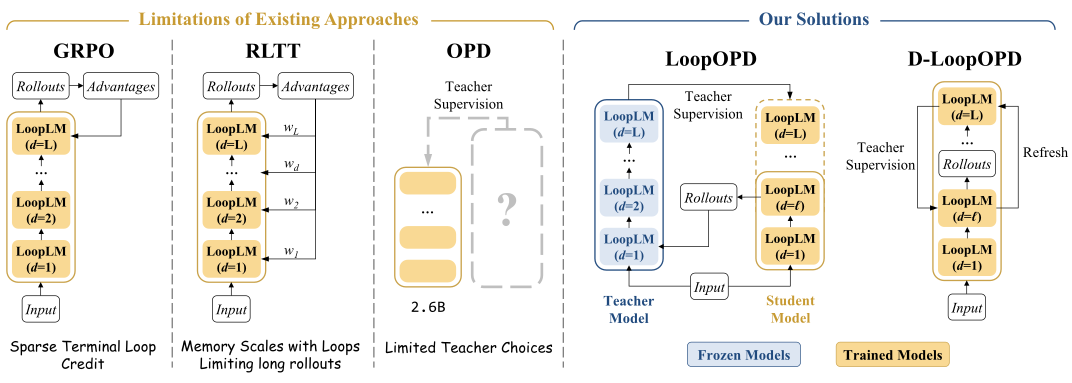
LoopOPD uses a model’s deeper loop as a teacher. D-LoopOPD refreshes that teacher through shared parameter updates, turning additional computation into an evolving source of supervision.
In a looped language model, intermediate and terminal loops share parameters but receive different amounts of computation. The terminal loop can therefore serve as a compute privileged teacher without a larger model or privileged information. LoopOPD turns this internal compute advantage into dense, token level supervision on the student’s own responses.
Both policies are evaluated on the same prompt and student generated response prefixes. The teacher’s compute advantage comes from additional recurrent depth. This gives looped models a source of supervision within the model itself, even when a stronger external teacher is unavailable.
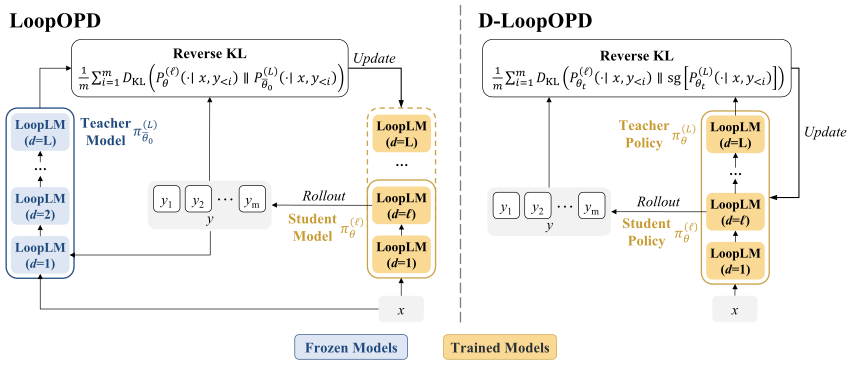
Both variants learn from a deeper loop teacher on student generated response prefixes. LoopOPD keeps its teacher frozen; D-LoopOPD refreshes its teacher through shared parameter updates.
LoopOPD samples responses from the intermediate loop student and distills the terminal loop teacher’s next token distributions into the student on the same prefixes. In our main experiments, loop 2 serves as the student and loop 4 as the teacher. The teacher in LoopOPD is a frozen copy of the initial model.
D-LoopOPD instead uses the current model’s terminal loop policy, with gradients stopped through the teacher distribution. Each student update changes the shared parameters and therefore the teacher used at the next step. Repeating this process turns cross loop distillation into recurrent self-improvement.
| Method | AIME 2024 | AIME 2025 | AIME 2026 |
Olympiad
Bench |
Beyond
AIME | |||
|---|---|---|---|---|---|---|---|---|
| Avg@16 | Pass@16 | Avg@16 | Pass@16 | Avg@16 | Pass@16 | |||
| Vanilla | 62.08 | 83.33 | 48.96 | 73.33 | 55.42 | 83.33 | 64.30 | 35.00 |
| GRPO | 62.92 | 86.67 | 49.79 | 73.33 | 57.08 | 86.67 | 64.59 | 35.00 |
| RLTT | 56.67 | 83.33 | 36.46 | 66.67 | 46.04 | 76.67 | 60.29 | 28.00 |
| OPSD | 60.42 | 83.33 | 43.13 | 70.00 | 50.62 | 73.33 | 63.26 | 30.00 |
| LoopOPD (Ours) | 65.21 | 90.00 | 53.75 | 80.00 | 59.17 | 90.00 | 64.88 | 33.00 |
| D-LoopOPD (Ours) | 71.67 | 90.00 | 55.21 | 80.00 | 60.21 | 86.67 | 65.78 | 34.00 |
| Method | AIME 2024 | AIME 2025 | AIME 2026 |
Olympiad
Bench |
Beyond
AIME | |||
|---|---|---|---|---|---|---|---|---|
| Avg@16 | Pass@16 | Avg@16 | Pass@16 | Avg@16 | Pass@16 | |||
| Vanilla | 51.25 | 73.33 | 41.25 | 70.00 | 45.21 | 73.33 | 59.40 | 24.00 |
| GRPO | 51.88 | 76.67 | 40.21 | 70.00 | 46.46 | 70.00 | 60.14 | 24.00 |
| RLTT | 50.00 | 80.00 | 37.50 | 66.67 | 41.87 | 66.67 | 60.44 | 22.00 |
| OPSD | 49.58 | 73.33 | 41.04 | 63.33 | 44.79 | 70.00 | 60.59 | 22.00 |
| OPD | 50.42 | 83.33 | 38.54 | 66.67 | 46.25 | 73.33 | 60.44 | 25.00 |
| LoopOPD (Ours) | 53.33 | 80.00 | 43.54 | 70.00 | 46.25 | 73.33 | 60.74 | 24.00 |
| D-LoopOPD (Ours) | 55.00 | 86.67 | 43.54 | 73.33 | 47.92 | 76.67 | 60.59 | 27.00 |
All values are percentages. AIME reports Avg@16 and Pass@16; OlympiadBench and BeyondAIME report accuracy. Maximum response length: 31,744 tokens. Bold values are best within the selected Ouro model group.
| Model | Method | AIME 2024 | AIME 2025 | AIME 2026 |
Olympiad
Bench |
Beyond
AIME | |||
|---|---|---|---|---|---|---|---|---|---|
| Avg@16 | Pass@16 | Avg@16 | Pass@16 | Avg@16 | Pass@16 | ||||
| Qwen3-1.7B | Vanilla | 47.92 | 76.67 | 36.46 | 56.67 | 38.13 | 76.67 | 56.30 | 15.00 |
| GRPO | 51.04 | 73.33 | 37.50 | 56.67 | 40.42 | 80.00 | 57.19 | 17.00 | |
| Qwen3-4B | Vanilla | 61.25 | 83.33 | 52.08 | 73.33 | 52.92 | 76.67 | 68.44 | 31.00 |
| GRPO | 65.42 | 83.33 | 51.67 | 76.67 | 55.21 | 80.00 | 68.89 | 32.00 | |
| Qwen3.5-4B | Vanilla | 54.79 | 90.00 | 51.46 | 73.33 | 55.00 | 80.00 | 61.63 | 23.00 |
| Qwen3-8B | Vanilla | 71.25 | 90.00 | 64.38 | 83.33 | 66.67 | 86.67 | 69.48 | 37.00 |
| GRPO | 73.54 | 93.33 | 68.96 | 83.33 | 69.38 | 86.67 | 71.26 | 38.00 | |
| Qwen3.5-9B | Vanilla | 72.08 | 93.33 | 61.46 | 86.67 | 66.04 | 86.67 | 64.89 | 36.00 |
Qwen comparison results from Table 2. Qwen models use thinking mode. The selected Ouro results above use terminal loop d = 4.
| Method | MMLU | MBPP | MBPP+ | HumanEval | HumanEval+ |
|---|---|---|---|---|---|
| Vanilla | 76.09 | 74.87 | 62.43 | 78.66 | 74.39 |
| GRPO | 76.32 | 75.13 | 62.17 | 78.05 | 74.39 |
| RLTT | 76.11 | 75.40 | 61.90 | 81.71 | 77.44 |
| OPSD | 75.84 | 74.87 | 62.70 | 76.83 | 72.56 |
| LoopOPD (Ours) | 76.09 | 75.40 | 62.70 | 78.66 | 74.39 |
| D-LoopOPD (Ours) | 76.67 | 75.93 | 63.76 | 79.27 | 75.00 |
| Method | MMLU | MBPP | MBPP+ | HumanEval | HumanEval+ |
|---|---|---|---|---|---|
| Vanilla | 67.78 | 72.22 | 62.70 | 74.39 | 70.12 |
| GRPO | 67.51 | 72.49 | 62.70 | 75.00 | 71.95 |
| RLTT | 68.01 | 73.02 | 62.70 | 77.44 | 71.34 |
| OPSD | 66.50 | 71.96 | 61.11 | 74.39 | 69.51 |
| OPD | 67.83 | 72.22 | 62.43 | 74.39 | 70.12 |
| LoopOPD (Ours) | 68.05 | 72.22 | 62.70 | 76.22 | 71.34 |
| D-LoopOPD (Ours) | 67.87 | 73.28 | 63.23 | 76.22 | 71.95 |
All values are percentages. MMLU reports accuracy; MBPP, MBPP+, HumanEval, and HumanEval+ report Pass@1. Bold values are best within the selected Ouro model group. Post-training uses only DAPO-Math-17k.
| Model | Method | MMLU | MBPP | MBPP+ | HumanEval | HumanEval+ |
|---|---|---|---|---|---|---|
| Qwen3-1.7B | Vanilla | 60.21 | 59.26 | 50.26 | 69.51 | 63.41 |
| GRPO | 61.00 | 60.05 | 50.00 | 71.34 | 64.63 | |
| Qwen3-4B | Vanilla | 70.07 | 68.78 | 59.79 | 77.44 | 70.73 |
| GRPO | 68.49 | 67.99 | 60.85 | 75.61 | 69.51 | |
| Qwen3.5-4B | Vanilla | 69.66 | 75.40 | 61.11 | 82.93 | 76.83 |
| Qwen3-8B | Vanilla | 74.89 | 71.69 | 62.43 | 84.15 | 73.78 |
| GRPO | 74.48 | 71.96 | 63.23 | 85.37 | 75.00 | |
| Qwen3.5-9B | Vanilla | 69.90 | 79.10 | 64.81 | 86.59 | 82.32 |
Qwen comparison results from Table 3. Qwen models use thinking mode. The selected Ouro results above use terminal loop d = 4.
On Ouro-2.6B-Thinking, D-LoopOPD raises mean Avg@16 across AIME 2024, 2025, and 2026 from 55.49% (vanilla) to 62.36%. Its AIME 2024 score of 71.67% is comparable to vanilla Qwen3-8B’s 71.25%, with fewer parameters. The gains also extend to MMLU, MBPP, MBPP+, HumanEval, and HumanEval+, despite training only on DAPO-Math-17k.
In the main setting, only loop 2 receives direct distillation supervision, yet improvements extend across all four loop depths. On AIME 2024, D-LoopOPD improves the student loop by 8.34 percentage points and the terminal loop by 9.59 points. The experiments also examine how the gains depend on the decoding budget and the choice of student depth.
D-LoopOPD improves AIME 2024 Avg@16 over the vanilla model at every evaluated depth. Loop 2 receives the distillation objective; the gains extend to the terminal loop through shared parameters.
Table 5 · Ouro-2.6B-Thinking · AIME 2024 Avg@16 (%)
| Method | Loop 1 | Loop 2 | Loop 3 | Loop 4 |
|---|---|---|---|---|
| Vanilla | 0.63 | 39.16 | 61.46 | 62.08 |
| RLTT | 0.00 | 26.87 | 49.58 | 56.67 |
| GRPO | 0.42 | 41.88 | 62.92 | 62.92 |
| LoopOPD (Ours) | 1.25 | 45.62 | 63.33 | 65.21 |
| D-LoopOPD (Ours) | 1.88 | 47.50 | 66.87 | 71.67 |
All values are percentages. AIME 2024 Avg@16; higher is better. Bold values are best within each column.
RLTT improves short budget performance but falls below vanilla at 16K and 31K. In contrast, D-LoopOPD exceeds vanilla across all decode budgets, reaching 71.67% at 31K compared with 62.08% for vanilla. These results suggest that D-LoopOPD improves reasoning performance across decoding budgets without sacrificing long budget capability for short budget gains.
Table 6 · Ouro-2.6B-Thinking · AIME 2024 Avg@16 (%)
| Method | 1K | 2K | 4K | 8K | 16K | 31K |
|---|---|---|---|---|---|---|
| Vanilla | 0.00 | 3.75 | 13.95 | 32.29 | 55.00 | 62.08 |
| RLTT | 4.38 | 23.33 | 34.16 | 45.21 | 53.95 | 56.67 |
| D-LoopOPD (Ours) | 0.00 | 3.96 | 16.87 | 36.45 | 58.33 | 71.67 |
All values are percentages. AIME 2024 Avg@16; higher is better. Bold values are best within each column.
These results suggest a balance between student capability and the teacher's advantage from additional recurrent computation. Among student loops 1, 2, and 3, supervising loop 2 yields the highest terminal loop AIME 2024 Avg@16.
Figure 5 · Ouro-2.6B-Thinking · Terminal-loop AIME 2024 Avg@16 (%)
| Method | Loop 1 as student | Loop 2 as student | Loop 3 as student |
|---|---|---|---|
| Vanilla terminal loop | 62.08 | 62.08 | 62.08 |
| Trained terminal loop (Ours) | 68.54 | 71.67 | 67.29 |
All values are percentages. AIME 2024 Avg@16; higher is better. Bold values are best within each column.
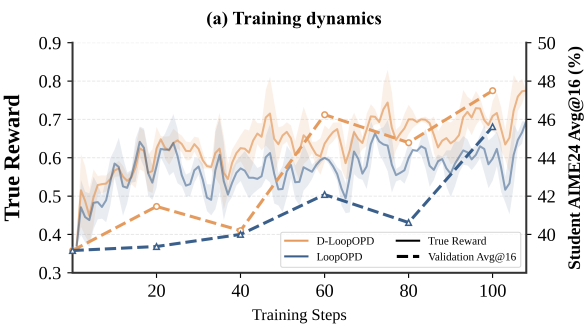
D-LoopOPD achieves higher training reward and student loop validation performance than LoopOPD. Solid lines show training reward, while dashed lines show student loop AIME 2024 validation Avg@16.
If you find LoopOPD useful for your research, please consider citing our paper:
@article{wang2026recurrent, title={Recurrent Self-Improvement: Dynamic Cross-Loop On-Policy Distillation for Looped Language Models}, author={Wang, Yi and Qian, Rui and Li, Yu and Yao, Haoyang and Wang, Wenjie}, journal={arXiv preprint arXiv:2610.10623}, year={2026}}