
EVA
Editing for Versatile Alignment
against Jailbreaks
IEEE TPAMI 2026
1ShanghaiTech University, ASPIRE Lab
Impact
Safety alignment through model editing.
Jailbreaks can exploit both textual and visual inputs. EVA treats safety alignment as a targeted model editing task: it identifies harmful key representations, optimizes safe target values, and updates selected MLP weights. The framework applies to both LLMs and VLMs, with regularization to limit changes on benign inputs.
Experiments show reduced jailbreak success with largely retained utility across text and multimodal benchmarks.
Before and after EVA
| Metric | Before | After EVA |
|---|---|---|
| MM-SafetyBench · ASR (%) ↓ | ||
| SD | 14 | 3 |
| TYPO | 48 | 6 |
| SD+TYPO | 48 | 3 |
| General utility · Score ↑ | ||
| MM-Vet-v2 | 69.1 | 69.3 |
| MMMU | 57.6 | 57.6 |
| MMStar | 68.3 | 67.5 |
| Metric | Before | After EVA |
|---|---|---|
| MM-SafetyBench · ASR (%) ↓ | ||
| SD | 11 | 1 |
| TYPO | 40 | 0 |
| SD+TYPO | 51 | 0 |
| General utility · Score ↑ | ||
| MM-Vet-v2 | 56.9 | 55.5 |
| MMMU | 49.9 | 48.2 |
| MMStar | 60.1 | 60.9 |
| Metric | Before | After EVA |
|---|---|---|
| MM-SafetyBench · ASR (%) ↓ | ||
| SD | 13 | 3 |
| TYPO | 12 | 0 |
| SD+TYPO | 37 | 13 |
| General utility · Score ↑ | ||
| MM-Vet-v2 | 28.5 | 28.3 |
| MMMU | 31.3 | 33.4 |
| MMStar | 32.5 | 32.3 |
Tables 3 & 5 · SD: harmful images generated by Stable Diffusion; TYPO: harmful text in images (OCR attacks); SD+TYPO: combines both.
Overview
Where does EVA fit?
EVA applies safety edits during downstream adaptation, after foundational alignment. The updated weights are then deployed in place of the original weights.

Why Use Targeted Model Editing After Release?
A released model can encounter jailbreaks that its initial safety alignment did not anticipate. Broad safety fine-tuning can alter useful capabilities, while external defenses add components to the inference pipeline. EVA instead uses localized parameter edits to modify the model’s response to harmful concepts without adding inference-time defense components.
Methodology
How Does EVA Edit a Model?

From Harmful Keys to Safe Values
EVA identifies harmful textual and visual key representations, optimizes target values that favor safe refusals, and writes the new mappings into selected MLP down-projection weights.
Together, these steps incorporate targeted safety corrections directly into the model weights. Once editing is complete, the updated model can be deployed without an additional inference-time defense module.
Results
How Does EVA Balance Safety and Utility?
Textual jailbreaks · ASR ↓
Table 1| Method | HarmBench | AdvBench | JailbreakBench | MaliciousInstruct | ||||||||
|---|---|---|---|---|---|---|---|---|---|---|---|---|
| GCG | AutoDAN | PAIR | GCG | AutoDAN | PAIR | GCG | AutoDAN | PAIR | GCG | AutoDAN | PAIR | |
| Vanilla | 92% | 69% | 80% | 89% | 78% | 75% | 89% | 73% | 77% | 94% | 83% | 86% |
| LoRA | 40% | 22% | 26% | 18% | 29% | 13% | 32% | 22% | 20% | 8% | 32% | 16% |
| SafeDecoding | 7% | 17% | 16% | 4% | 20% | 8% | 3% | 18% | 15% | 1% | 8% | 11% |
| LED | 3% | 11% | 4% | 6% | 9% | 5% | 34% | 8% | 6% | 5% | 10% | 5% |
| Circuit Breakers | 9% | 10% | 3% | 5% | 2% | 8% | 15% | 12% | 3% | 2% | 7% | 12% |
| EVA (text) (Ours) | 11% | 4% | 10% | 2% | 2% | 5% | 17% | 8% | 11% | 1% | 5% | 5% |
Textual jailbreaks · ASR ↓
Table 1| Method | HarmBench | AdvBench | JailbreakBench | MaliciousInstruct | ||||||||
|---|---|---|---|---|---|---|---|---|---|---|---|---|
| GCG | AutoDAN | PAIR | GCG | AutoDAN | PAIR | GCG | AutoDAN | PAIR | GCG | AutoDAN | PAIR | |
| Vanilla | 42% | 23% | 2% | 39% | 19% | 1% | 46% | 27% | 4% | 45% | 30% | 0% |
| LoRA | 13% | 1% | 2% | 2% | 0% | 0% | 50% | 1% | 2% | 32% | 0% | 0% |
| SafeDecoding | 0% | 0% | 1% | 4% | 0% | 4% | 1% | 0% | 3% | 1% | 0% | 0% |
| LED | 2% | 2% | 1% | 0% | 1% | 0% | 8% | 2% | 4% | 8% | 2% | 1% |
| Circuit Breakers | 0% | 2% | 1% | 0% | 0% | 0% | 0% | 0% | 0% | 1% | 1% | 0% |
| EVA (text) (Ours) | 0% | 0% | 0% | 0% | 0% | 0% | 0% | 0% | 0% | 1% | 0% | 0% |
Textual jailbreaks · ASR ↓
Table 1| Method | HarmBench | AdvBench | JailbreakBench | MaliciousInstruct | ||||||||
|---|---|---|---|---|---|---|---|---|---|---|---|---|
| GCG | AutoDAN | PAIR | GCG | AutoDAN | PAIR | GCG | AutoDAN | PAIR | GCG | AutoDAN | PAIR | |
| Vanilla | 80% | 87% | 88% | 56% | 97% | 82% | 79% | 95% | 89% | 94% | 96% | 92% |
| LoRA | 35% | 55% | 42% | 30% | 60% | 25% | 38% | 62% | 34% | 40% | 55% | 44% |
| SafeDecoding | 16% | 15% | 20% | 12% | 22% | 18% | 18% | 14% | 22% | 14% | 24% | 16% |
| LED | 20% | 18% | 19% | 6% | 26% | 16% | 10% | 12% | 10% | 12% | 25% | 12% |
| Circuit Breakers | 8% | 5% | 17% | 3% | 14% | 2% | 3% | 5% | 12% | 10% | 19% | 10% |
| EVA (text) (Ours) | 6% | 8% | 15% | 2% | 11% | 0% | 2% | 11% | 16% | 14% | 12% | 10% |
Textual jailbreaks · ASR ↓
Table 1| Method | HarmBench | AdvBench | JailbreakBench | MaliciousInstruct | ||||||||
|---|---|---|---|---|---|---|---|---|---|---|---|---|
| GCG | AutoDAN | PAIR | GCG | AutoDAN | PAIR | GCG | AutoDAN | PAIR | GCG | AutoDAN | PAIR | |
| Vanilla | 56% | 20% | 12% | 47% | 31% | 4% | 46% | 31% | 11% | 69% | 46% | 4% |
| LoRA | 41% | 27% | 14% | 34% | 33% | 4% | 37% | 35% | 9% | 42% | 47% | 6% |
| SafeDecoding | 0% | 4% | 0% | 0% | 1% | 0% | 0% | 1% | 1% | 0% | 1% | 0% |
| LED | 1% | 6% | 0% | 0% | 7% | 0% | 3% | 8% | 0% | 0% | 2% | 1% |
| Circuit Breakers | 0% | 4% | 3% | 0% | 0% | 0% | 0% | 0% | 0% | 1% | 1% | 0% |
| EVA (text) (Ours) | 0% | 0% | 0% | 1% | 0% | 0% | 2% | 0% | 0% | 0% | 0% | 0% |
Textual jailbreaks · ASR ↓
Table 1| Method | HarmBench | AdvBench | JailbreakBench | MaliciousInstruct | ||||||||
|---|---|---|---|---|---|---|---|---|---|---|---|---|
| GCG | AutoDAN | PAIR | GCG | AutoDAN | PAIR | GCG | AutoDAN | PAIR | GCG | AutoDAN | PAIR | |
| Vanilla | 49% | 74% | 66% | 46% | 80% | 39% | 42% | 80% | 55% | 80% | 96% | 54% |
| LoRA | 21% | 65% | 32% | 38% | 82% | 10% | 36% | 42% | 50% | 72% | 90% | 44% |
| SafeDecoding | 19% | 77% | 56% | 17% | 80% | 30% | 42% | 73% | 43% | 48% | 97% | 45% |
| LED | 1% | 0% | 5% | 0% | 0% | 2% | 0% | 0% | 1% | 0% | 0% | 2% |
| Circuit Breakers | 0% | 3% | 4% | 0% | 0% | 5% | 3% | 0% | 0% | 1% | 1% | 0% |
| EVA (text) (Ours) | 0% | 0% | 3% | 0% | 0% | 1% | 0% | 1% | 5% | 0% | 0% | 4% |
Attack success rate (ASR, %), lower is better. Bold values indicate the lowest ASR among defense methods, including ties. Attack success is judged by the HarmBench classifier.
Visual jailbreak attacks · ASR ↓
Table 3| Method | HarmBench | AdvBench | JailbreakBench | MaliciousInstruct | ||||||||
|---|---|---|---|---|---|---|---|---|---|---|---|---|
| FigStep | ADV-16 | Hades | FigStep | ADV-16 | Hades | FigStep | ADV-16 | Hades | FigStep | ADV-16 | Hades | |
| Vanilla | 33% | 71% | 38% | 43% | 39% | 44% | 39% | 61% | 54% | 68% | 83% | 26% |
| JailGuard | 25% | 56% | 26% | 32% | 30% | 30% | 31% | 47% | 35% | 55% | 62% | 16% |
| AdaShield-A | 1% | 0% | 0% | 0% | 0% | 0% | 2% | 0% | 0% | 1% | 0% | 0% |
| VLGuard | 0% | 0% | 0% | 0% | 0% | 0% | 0% | 0% | 0% | 0% | 0% | 0% |
| EVA (text) | 5% | 2% | 9% | 3% | 2% | 5% | 11% | 4% | 6% | 21% | 0% | 1% |
| EVA (Ours) | 0% | 0% | 0% | 0% | 0% | 1% | 0% | 0% | 0% | 0% | 0% | 0% |
Multimodal safety benchmarks · ASR ↓
Table 3| Method | MM-SafetyBench | MultiTrust | ||||
|---|---|---|---|---|---|---|
| SD | TYPO | SD + TYPO | Typographic | Multimodal | Cross-modal | |
| Vanilla | 13% | 12% | 37% | 26% | 53% | 88% |
| JailGuard | 11% | 9% | 29% | 15% | 39% | 42% |
| AdaShield-A | 2% | 1% | 10% | 2% | 8% | 7% |
| VLGuard | 4% | 2% | 14% | 4% | 6% | 7% |
| EVA (text) | 9% | 8% | 33% | 7% | 42% | 0% |
| EVA (Ours) | 3% | 0% | 13% | 1% | 13% | 0% |
Visual jailbreak attacks · ASR ↓
Table 3| Method | HarmBench | AdvBench | JailbreakBench | MaliciousInstruct | ||||||||
|---|---|---|---|---|---|---|---|---|---|---|---|---|
| FigStep | ADV-16 | Hades | FigStep | ADV-16 | Hades | FigStep | ADV-16 | Hades | FigStep | ADV-16 | Hades | |
| Vanilla | 32% | 15% | 19% | 26% | 18% | 12% | 4% | 8% | 56% | 7% | 17% | 47% |
| JailGuard | 16% | 8% | 13% | 15% | 7% | 2% | 2% | 7% | 26% | 3% | 10% | 29% |
| AdaShield-A | 10% | 9% | 1% | 9% | 0% | 4% | 0% | 0% | 31% | 4% | 0% | 12% |
| VLGuard | 0% | 0% | 0% | 0% | 1% | 0% | 0% | 0% | 1% | 0% | 0% | 0% |
| EVA (text) | 3% | 0% | 1% | 1% | 0% | 2% | 0% | 0% | 2% | 1% | 0% | 5% |
| EVA (Ours) | 0% | 0% | 0% | 0% | 0% | 0% | 0% | 0% | 0% | 0% | 0% | 0% |
Multimodal safety benchmarks · ASR ↓
Table 3| Method | MM-SafetyBench | MultiTrust | ||||
|---|---|---|---|---|---|---|
| SD | TYPO | SD + TYPO | Typographic | Multimodal | Cross-modal | |
| Vanilla | 11% | 40% | 51% | 3% | 35% | 10% |
| JailGuard | 9% | 30% | 37% | 2% | 25% | 8% |
| AdaShield-A | 5% | 27% | 27% | 0% | 6% | 5% |
| VLGuard | 2% | 11% | 11% | 1% | 8% | 10% |
| EVA (text) | 4% | 19% | 22% | 0% | 14% | 0% |
| EVA (Ours) | 1% | 0% | 0% | 0% | 0% | 0% |
Visual jailbreak attacks · ASR ↓
Table 3| Method | HarmBench | AdvBench | JailbreakBench | MaliciousInstruct | ||||||||
|---|---|---|---|---|---|---|---|---|---|---|---|---|
| FigStep | ADV-16 | Hades | FigStep | ADV-16 | Hades | FigStep | ADV-16 | Hades | FigStep | ADV-16 | Hades | |
| Vanilla | 22% | 11% | 17% | 5% | 4% | 3% | 15% | 10% | 9% | 30% | 22% | 21% |
| JailGuard | 16% | 8% | 13% | 4% | 3% | 2% | 11% | 7% | 6% | 22% | 16% | 15% |
| AdaShield-A | 1% | 5% | 4% | 0% | 0% | 0% | 1% | 2% | 7% | 2% | 1% | 1% |
| VLGuard | 0% | 1% | 1% | 0% | 0% | 0% | 0% | 0% | 2% | 1% | 0% | 0% |
| EVA (text) | 2% | 3% | 3% | 0% | 1% | 0% | 3% | 2% | 1% | 5% | 3% | 2% |
| EVA (Ours) | 1% | 0% | 0% | 0% | 0% | 0% | 1% | 0% | 0% | 2% | 0% | 0% |
Multimodal safety benchmarks · ASR ↓
Table 3| Method | MM-SafetyBench | MultiTrust | ||||
|---|---|---|---|---|---|---|
| SD | TYPO | SD + TYPO | Typographic | Multimodal | Cross-modal | |
| Vanilla | 14% | 48% | 48% | 3% | 33% | 7% |
| JailGuard | 10% | 36% | 35% | 2% | 24% | 5% |
| AdaShield-A | 3% | 12% | 9% | 0% | 5% | 1% |
| VLGuard | 2% | 8% | 11% | 0% | 4% | 2% |
| EVA (text) | 5% | 14% | 9% | 1% | 15% | 0% |
| EVA (Ours) | 3% | 6% | 3% | 0% | 0% | 0% |
Attack success rate (ASR, %), lower is better. ADV-16 images are optimized against LLaVA-1.5-7B and transferred to the other VLMs. EVA (text) uses only textual keys for editing.
General language capabilities ↑
Table 2| Method | MT-Bench | BoolQ | MuTual | CoNLL03 | RTE | GSM8K | SST2 | SAMSum |
|---|---|---|---|---|---|---|---|---|
| Score | QA | Dialogue | NER | NLI | Reasoning | Sentiment | Summary | |
| Vanilla | 6.77 | 0.777 | 0.483 | 0.287 | 0.563 | 0.982 | 0.862 | 0.272 |
| LoRA | 5.64 | 0.742 | 0.459 | 0.177 | 0.610 | 0.976 | 0.898 | 0.268 |
| SafeDecoding | 6.61 | 0.671 | 0.314 | 0.098 | 0.536 | 0.969 | 0.645 | 0.174 |
| LED | 3.70 | 0.760 | 0.478 | 0.265 | 0.558 | 0.974 | 0.831 | 0.267 |
| Circuit Breakers | 5.25 | 0.756 | 0.463 | 0.249 | 0.547 | 0.972 | 0.790 | 0.262 |
| EVA (text) (Ours) | 6.84 ↑ | 0.762 | 0.470 | 0.254 | 0.560 | 0.981 | 0.854 | 0.260 |
General language capabilities ↑
Table 2| Method | MT-Bench | BoolQ | MuTual | CoNLL03 | RTE | GSM8K | SST2 | SAMSum |
|---|---|---|---|---|---|---|---|---|
| Score | QA | Dialogue | NER | NLI | Reasoning | Sentiment | Summary | |
| Vanilla | 6.89 | 0.734 | 0.465 | 0.187 | 0.603 | 0.977 | 0.909 | 0.267 |
| LoRA | 6.90 | 0.769 | 0.480 | 0.288 | 0.551 | 0.976 | 0.854 | 0.259 |
| SafeDecoding | 6.17 | 0.688 | 0.327 | 0.099 | 0.518 | 0.976 | 0.872 | 0.227 |
| LED | 5.80 | 0.705 | 0.425 | 0.228 ↑ | 0.577 | 0.973 | 0.898 | 0.256 |
| Circuit Breakers | 6.05 | 0.712 | 0.444 | 0.185 | 0.559 | 0.971 | 0.881 | 0.260 |
| EVA (text) (Ours) | 6.31 | 0.718 | 0.462 | 0.228 ↑ | 0.612 ↑ | 0.974 | 0.905 | 0.251 |
General language capabilities ↑
Table 2| Method | MT-Bench | BoolQ | MuTual | CoNLL03 | RTE | GSM8K | SST2 | SAMSum |
|---|---|---|---|---|---|---|---|---|
| Score | QA | Dialogue | NER | NLI | Reasoning | Sentiment | Summary | |
| Vanilla | 7.93 | 0.852 | 0.664 | 0.498 | 0.694 | 0.941 | 0.962 | 0.255 |
| LoRA | 7.54 | 0.850 | 0.668 | 0.495 | 0.700 | 0.946 | 0.953 | 0.258 |
| SafeDecoding | 7.16 | 0.732 | 0.439 | 0.372 | 0.593 | 0.863 | 0.790 | 0.204 |
| LED | 7.09 | 0.803 | 0.662 | 0.431 | 0.679 | 0.937 | 0.918 | 0.221 |
| Circuit Breakers | 5.98 | 0.811 | 0.669 ↑ | 0.440 | 0.685 | 0.943 ↑ | 0.871 | 0.254 |
| EVA (text) (Ours) | 7.35 | 0.814 | 0.614 | 0.444 | 0.669 | 0.955 ↑ | 0.923 | 0.205 |
General language capabilities ↑
Table 2| Method | MT-Bench | BoolQ | MuTual | CoNLL03 | RTE | GSM8K | SST2 | SAMSum |
|---|---|---|---|---|---|---|---|---|
| Score | QA | Dialogue | NER | NLI | Reasoning | Sentiment | Summary | |
| Vanilla | 7.79 | 0.770 | 0.737 | 0.424 | 0.674 | 0.983 | 0.922 | 0.254 |
| LoRA | 8.14 | 0.782 | 0.737 | 0.433 | 0.672 | 0.982 | 0.918 | 0.254 |
| SafeDecoding | 8.05 ↑ | 0.746 | 0.340 | 0.223 | 0.572 | 0.969 | 0.617 | 0.136 |
| LED | 7.29 | 0.768 | 0.684 | 0.468 ↑ | 0.597 | 0.981 | 0.863 | 0.251 |
| Circuit Breakers | 7.21 | 0.489 | 0.660 | 0.390 | 0.643 | 0.977 | 0.862 | 0.252 |
| EVA (text) (Ours) | 7.44 | 0.752 | 0.744 ↑ | 0.423 | 0.686 ↑ | 0.985 ↑ | 0.890 | 0.256 ↑ |
General language capabilities ↑
Table 2| Method | MT-Bench | BoolQ | MuTual | CoNLL03 | RTE | GSM8K | SST2 | SAMSum |
|---|---|---|---|---|---|---|---|---|
| Score | QA | Dialogue | NER | NLI | Reasoning | Sentiment | Summary | |
| Vanilla | 8.82 | 0.840 | 0.790 | 0.510 | 0.835 | 0.987 | 0.928 | 0.254 |
| LoRA | 8.39 | 0.840 | 0.790 | 0.507 | 0.833 | 0.988 | 0.925 | 0.258 |
| SafeDecoding | 8.32 | 0.838 | 0.802 ↑ | 0.509 | 0.831 | 0.987 | 0.870 | 0.239 |
| LED | 7.87 | 0.819 | 0.808 ↑ | 0.499 | 0.807 | 0.987 | 0.903 | 0.254 |
| Circuit Breakers | 7.91 | 0.797 | 0.788 | 0.504 | 0.813 | 0.987 | 0.896 | 0.254 |
| EVA (text) (Ours) | 8.48 | 0.832 | 0.798 ↑ | 0.510 | 0.833 | 0.988 ↑ | 0.910 | 0.256 ↑ |
Higher scores indicate better utility. Bold values mark the best scores among defense methods (excluding LoRA), including ties. ↑ indicates improvements over Vanilla.
General multimodal capabilities ↑
Table 5| Method | MM-Vet-v2 | MMMU | MMStar |
|---|---|---|---|
| Score | Score | Score | |
| Vanilla | 28.5 | 31.3 | 32.5 |
| JailGuard | 26.5 | 29.8 | 31.0 |
| AdaShield-A | 14.1 | 19.7 | 19.2 |
| VLGuard | 28.1 | 32.1 | 32.3 |
| EVA (text) | 28.6 | 33.3 | 27.3 |
| EVA (Ours) | 28.3 | 33.4 | 32.3 |
General multimodal capabilities ↑
Table 5| Method | MM-Vet-v2 | MMMU | MMStar |
|---|---|---|---|
| Score | Score | Score | |
| Vanilla | 56.9 | 49.9 | 60.1 |
| JailGuard | 54.5 | 47.5 | 59.2 |
| AdaShield-A | 33.2 | 35.4 | 39.8 |
| VLGuard | 46.6 | 50.2 | 61.6 |
| EVA (text) | 55.7 | 49.6 | 61.1 |
| EVA (Ours) | 55.5 | 48.2 | 60.9 |
General multimodal capabilities ↑
Table 5| Method | MM-Vet-v2 | MMMU | MMStar |
|---|---|---|---|
| Score | Score | Score | |
| Vanilla | 69.1 | 57.6 | 68.3 |
| JailGuard | 64.4 | 55.8 | 66.5 |
| AdaShield-A | 46.2 | 38.4 | 44.7 |
| VLGuard | 67.5 | 57.1 | 67.0 |
| EVA (text) | 69.0 | 57.0 | 67.6 |
| EVA (Ours) | 69.3 | 57.6 | 67.5 |
Higher scores indicate better utility. Bold values mark the best scores among defense methods, including ties.
Across five LLMs and three VLMs, EVA substantially reduces jailbreak ASR under diverse textual and visual attacks while retaining most general task utility.
How Does Visual Token Selection Affect Robustness?
We compare edits built from scene content, OCR text, and composite inputs. Select a variant to inspect its permitted visual token region and measured attack success.
Which image regions matter?

Highlighted: permitted visual token selection region.
EVA · composite editing
Use composite editing images and allow visual token selection across both scene and OCR regions.
Compare all editing variants Table 8
| Method | SD ↓ | TYPO ↓ | SD+TYPO ↓ |
|---|---|---|---|
| Vanilla | 14% | 48% | 48% |
| EVA | 3% | 6% | 3% |
| EVA (Image-Focused) | 6% | 17% | 7% |
| EVA (Image-Only) | 3% | 36% | 16% |
| EVA (TYPO-Focused) | 10% | 4% | 27% |
| EVA (TYPO-Only) | 13% | 2% | 39% |
| Vanilla | 11% | 40% | 51% |
| EVA | 1% | 0% | 0% |
| EVA (Image-Focused) | 1% | 15% | 12% |
| EVA (Image-Only) | 0% | 18% | 13% |
| EVA (TYPO-Focused) | 5% | 0% | 25% |
| EVA (TYPO-Only) | 10% | 0% | 40% |
MM-SafetyBench ASR (%), lower is better. Focused variants use composite images with restricted token selection; Only variants use images containing either scene content or rendered text.
How Many Visual Tokens Should Be Selected?
Selecting one visual token reduces ASR from 48% to 3% while keeping MM-Vet-v2 at 69.3, compared with 69.1 for the original model. Selecting more tokens lowers ASR further but reduces utility in this ablation.
InternVL3.5-8B
Visual token selection3%
Original 48%
69.3
Original 69.1
Critical layers Figures 3 & 4
Layer sweeps identify layer 8 for Qwen2.5-VL-7B and layer 9 for InternVL3.5-8B as providing the best safety utility trade-offs. Both match the critical layers of their LLM backbones.
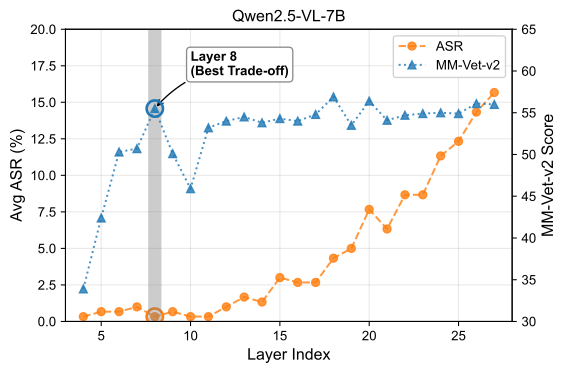
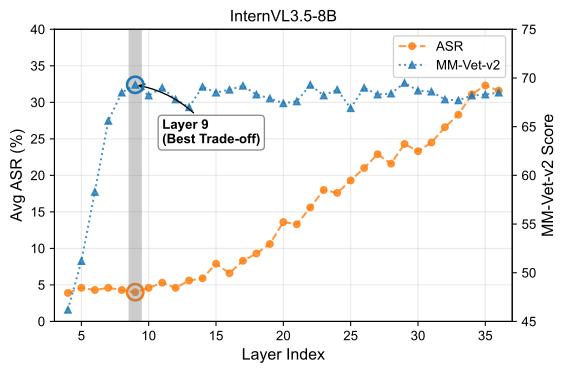
Do edits transfer to other harmful behaviors? Figures 5 & 6
We edit one HarmBench behavior category at a time and evaluate all six categories. On Llama2-7B-chat under GCG and LLaVA-1.5-7B under Hades, the heatmaps show reduced attack success on categories not used for editing.
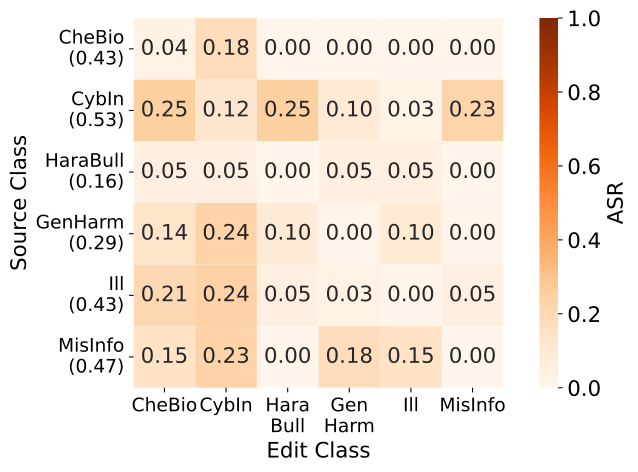
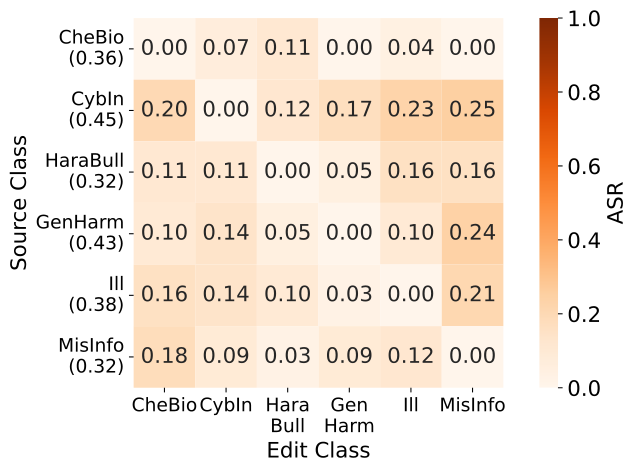
Columns denote editing categories, and rows denote evaluated categories. Off-diagonal cells show transfer to other categories; original ASR values appear in parentheses. ASR is shown on a 0–1 scale (lower is better).
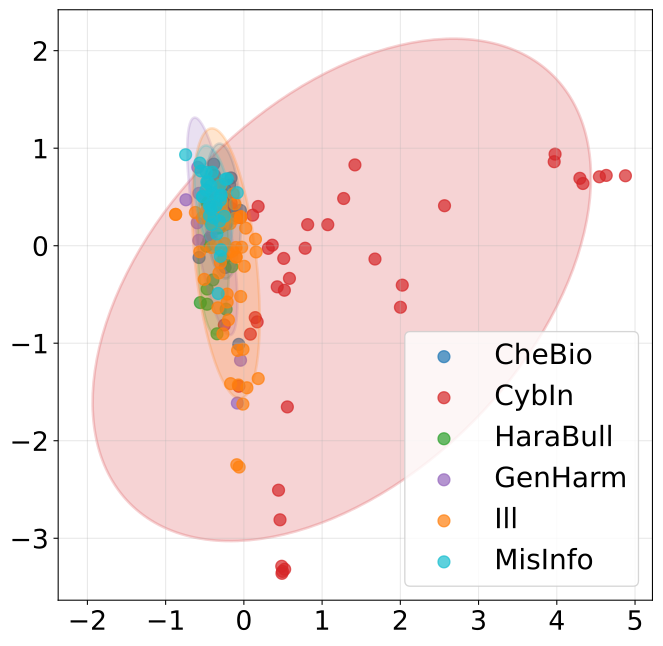
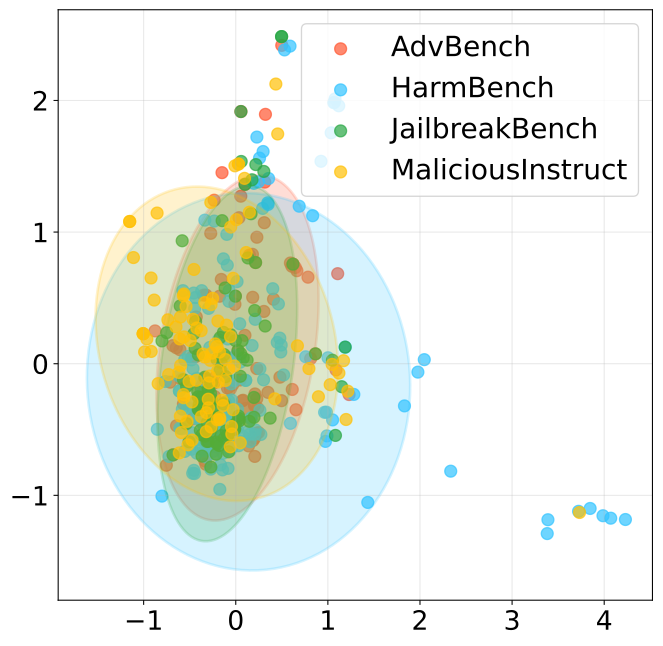
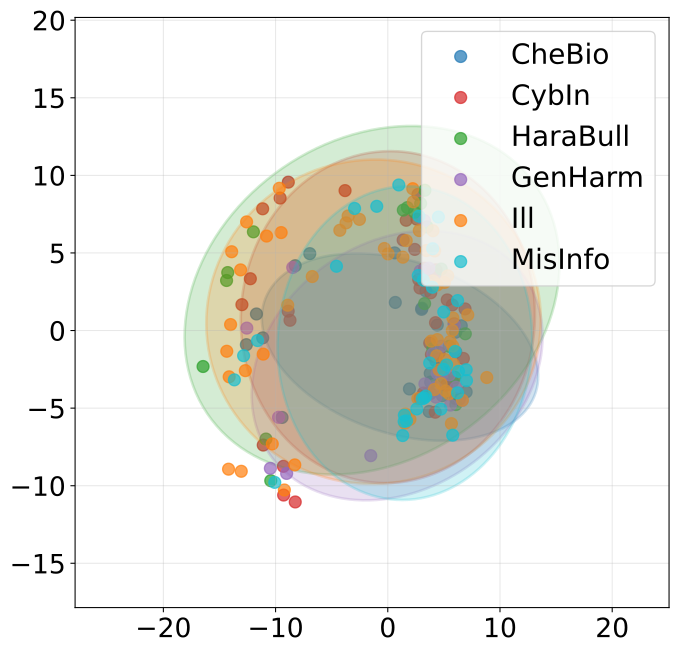
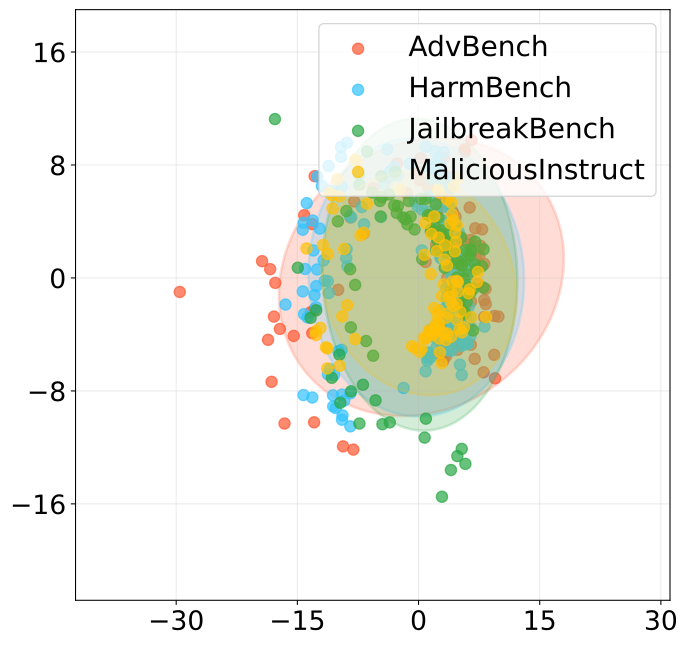
What do the key representations show? Figure 7
We visualize harmful key representations at the selected editing layers using PCA. Textual keys from Llama2 and visual keys from Qwen2.5-VL show substantial overlap across behavior categories and datasets, suggesting shared representation patterns among harmful inputs.
Editing Cost and Deployment
Training time ↓
0.8 h
EVA requires 0.8 hours of training on InternVL3.5-8B, compared with 2.0 hours for VLGuard and 1.2 hours for AdaShield-A.
Single NVIDIA A40 GPU · Averaged over five runs.
Training time from Table 9. "—" indicates no training is required. Lower is better.
Citation
If you find EVA useful for your research, please consider citing our paper:
@ARTICLE{wang2026eva, author={Wang, Yi and Qiu, Hongye and Xu, Yue and Yang, Sibei and Qin, Zhan and Huang, Minlie and Wang, Wenjie}, journal={IEEE Transactions on Pattern Analysis and Machine Intelligence}, title={EVA: Editing for Versatile Alignment Against Jailbreaks}, year={2026}, volume={48}, number={10}, pages={11776-11791}, keywords={Automatic speech recognition;Modeling;Safety;Visualization;Large language models;Conferences;Optimization;Educational institutions;Light emitting diodes;Tuning;Safety alignment;jailbreak attacks;model editing;large language models;vision language models}, doi={10.1109/TPAMI.2026.3694189}}